
Skip to content

Sermons

Two Kings of a Divided Kingdom
1 Kings, Part 151 Kings 12:15-20

Two Kings of a Divided Kingdom

This passage covers the case of Ammon, which misread David's kindness and chose war, and the story of Rehoboam, who after Solomon's death refused the people's demands and split the kingdom. It also sheds light on the foolish decision of Jeroboam, who, though he had received God's promise, chose idolatry to protect his own position.

The sermon points out that the failures these figures experienced were not simply fate, but the result of wrong judgments that grew out of their own sense of inferiority and suspicion. In particular, it emphasizes that God's warnings and judgment are in the end a Father's pleading for repentance and turning back, and it urges us not to distort the true nature of our circumstances but to choose with discernment.

So that we do not repeat the mistakes of the two kings, who doubted God's love and his choosing and rushed headlong down the path of sin, how must we discern and choose by faith?
Pastor Lee Ji-hyun · Nov 3, 2024
For the Sake of God’s Choosing
1 Kings, Part 141 Kings 11:9-13

For the Sake of God’s Choosing

Today's passage shows, through the life of King Solomon, how God's choosing and human choices flow together. Solomon had received God's special love and wisdom from birth, but in his later years he fell into idolatry through foreign women and committed a grave error. God resolved not to tolerate his apostasy, yet for the sake of his covenant with David and for Jerusalem, he did not take the kingdom away entirely but left one tribe. This shows that human failure and corruption cannot nullify God's plan and covenant.

Through the laws for the king that Solomon failed to keep, the sermon points out how he came to rely on the world's power and pride. He broke the command not to multiply horses and built up his military strength, and he married foreign women and his heart was led astray. He also piled up wealth and did not meditate on the Law, neglecting his relationship with God. These sins were intertwined and in the end led to the grave mistake of apostasy, which warns how dangerous it is to allow small sins with a complacent heart.

Despite Solomon's failure, God did not abandon him to the very end, and carried on his work of salvation. This means that God's faithfulness is greater than human unfaithfulness. We must remember that having been saved does not give us permission to live as we please. Rather, to live as God's children, we must fight a spiritual battle to bring our lives into line with God's word. Can we live a life that loves and relies on God alone, whatever the currents of the world?

Pastor Lee Ji-hyun · Oct 20, 2024
A Shadow Cast in the Midst of Glory
1 Kings, Part 131 Kings 10:4-10

A Shadow Cast in the Midst of Glory

This passage covers the Queen of Sheba, who heard of Solomon's wisdom and fame and traveled a long way to visit Jerusalem. The queen was deeply moved by the well-ordered national system under Solomon's rule and by his wisdom; she praised God and brought enormous gifts. This shows that Solomon's life, made by God's grace, became a channel that revealed God's glory even to the Gentiles.

Behind this glorious scene, however, it comes to light that Solomon was walking the path of compromise, taking God's commands lightly, trading with Gentiles and even handing over land. God did not stop Solomon at once when he sinned but left him alone, both out of a heart of love that waited for him to repent and return, and in order to draw, through his life, those who would come to God. We look back on whether, though we have already received much grace, we still demand that God show us what his will is, or pursue worldly success and prosperity and lose sight of God.

This passage tells us that, to connect the grace we have already received with the blessing of salvation, we must turn the direction of our lives completely around and live in obedience to God's commands. What question is it putting to us?

Pastor Lee Ji-hyun · Oct 6, 2024
A Living Dog Is Better Than a Dead Lion
Ecclesiastes, Part 17Ecclesiastes 9:1-10

A Living Dog Is Better Than a Dead Lion

This passage deals with the emptiness of life and with what we should truly set our hearts on. The writer himself realizes that the authority and wealth he holds mean nothing in the face of death, and declares that those who live in a low place, repenting daily and obeying God, are more precious.

Through the parable of the unjust steward, the sermon points out the need for wisdom to discern the master's will. The world praises those who hold on to what is theirs and pile it up, but God delights in the good steward who has compassion on the poor and shares. Believers must acknowledge that what they own has been entrusted to them by God for a while, and must use it according to God's will, not for their own pleasure or power.

The sermon asks believers not to be bound to the world's empty glory, but to live the life of a good steward as those whose sins have been washed away by the blood of Christ alone. Before we cross the bridge of death, it leads us to look back on whether our lives right now look like those of children who fear God, or like the unjust steward who builds up his own righteousness in the darkness.

Pastor Cho Chun-sook · Sep 29, 2024
The Love That Speaks of Judgment
1 Kings, Part 121 Kings 9:1-9

The Love That Speaks of Judgment

This passage covers Solomon standing before God after completing the building of the temple. Solomon prays, believing that since he has built the temple by his own efforts, God's promise will be kept. But God sets out a condition more important than the success of the temple building: to keep one's heart whole, as David did, and to obey God's statutes.

God warns that however beautiful the temple is, it can be destroyed if the people lose the heart of the covenant and disobey. This is a message of love, spoken not because he wants judgment to come, but to lead the people out of the place of sin and into the place of salvation. Yet while Solomon prayed for the sins of the people, he did not repent of his own sin, especially the matter of having foreign wives.

Through Solomon, who did not first look at his own sin but only demanded the promise, God shows that prayer offered without true repentance can instead become a warning of judgment. The sermon asks believers to examine themselves so that they do not grow proud, drunk on a sense of achievement, and to offer honest prayers.

Pastor Lee Ji-hyun · Sep 8, 2024
Paul and Silas, Who Had True Hope (21st Founding Anniversary)
ActsActs 16:16-40

Paul and Silas, Who Had True Hope (21st Founding Anniversary)

This passage covers the persecution and imprisonment that Paul and Silas went through after healing a slave girl possessed by a spirit in Philippi. As they preached the gospel they were driven into extreme circumstances of insults, beatings and prison, yet even at midnight they offered prayers and praise, revealing God's presence.

When an earthquake opened the prison doors and gave them a chance to escape, Paul stayed to save the jailer's life. His honest and holy choice drew from the jailer an earnest question about salvation, and in the end the jailer and his whole household received Christ. And Paul's boldly exercising the authority of his Roman citizenship and making his status known shows wisdom and courage for the spread of the gospel.

We look at how these hardships and choices led to the salvation of souls and the growth of the church. We must think deeply about what choices we will make now, and how we must live to stand on a rock of faith that the world cannot treat lightly.

Pastor Cho Chun-sook · Sep 1, 2024
The Temple Being Built Together
1 Kings, Part 111 Kings 8:27-30, 56-61

The Temple Being Built Together

Today's passage contains the prayer and blessing Solomon offered to God after completing the temple. Solomon confesses the infinity of God, whom heaven and earth cannot contain, and declares that the temple is not a mere building but the place where God hears and meets his people's prayers. At its heart is his prayer of intercession: that when the people suffer because of sin and sincerely repent and pray, God will forgive and restore them in his justice and mercy.

This passage leads us to reflect deeply on what it means for us to walk before God ‘with all our heart’. It asks what true faith is, the faith that obeys God's will beyond our understanding, as Abraham did when he offered Isaac. It also shows how, though salvation is given wholly by grace, our lives, as we respond to that grace and walk the path of sanctification, can be in harmony with God. It emphasizes that the temple is now not a building but believers united with Christ, and that our whole lives must become the ground that bears witness to God.

Relying on God's grace, how can we carry out our mission as the temple through the relationships in which we meet one another? We invite you to consider together what a true temple looks like, one in which God's work is revealed in every area of life.

Pastor Lee Ji-hyun · Aug 25, 2024
Where God Dwells
1 Kings, Part 101 Kings 8:12-21

Where God Dwells

This passage begins with the question of whether the word that God would dwell in the thick darkness conflicts with the statement that a temple was built as a place for him to dwell forever. Generally light symbolizes God and darkness stands for evil, but in many places in the Bible God is present in thick darkness. This shows that human wisdom cannot fully know the being of the infinite God.

The temple is a place fit for God to put his name, a place granted where God himself is present. But the passage emphasizes that the temple is not merely a building, and that God is with his people only when his covenant with them is faithfully kept. When the people of Israel broke the covenant, the temple was destroyed, and the same obedience and faith are required of us today.

The sermon asks how we are welcoming God, who is everywhere and loves us. It leads us to consider what it looks like to become humble before God's infinity, obey his word, and keep growing to the end.

Pastor Lee Ji-hyun · Aug 18, 2024
The Wise Man Who Does Not Grasp God’s Greatness
Ecclesiastes, Part 16Ecclesiastes 8:9-17

The Wise Man Who Does Not Grasp God’s Greatness

This passage deals with the frustration believers feel as they see the injustice of the world and the long lives of the wicked. Solomon points out that because the wicked are not judged at once, they sin boldly, and he explains that this is because God is being patient to give them an opportunity to repent. The world's abundance and long life are in the end empty things that vanish like a shadow, and the passage emphasizes that true blessing lies in eternal life after death.

Through the case of Judas Iscariot, the sermon shows how someone who knows the Word but whose heart has not been changed becomes a tool of Satan. And through the experience of Solomon, who enjoyed power and wisdom yet did not fear God and in the end felt only emptiness, it teaches that human wisdom and effort alone cannot bring true satisfaction. Believers must not be swallowed up by the world's standards, but must understand God's patience and hope for eternal life through faith in Christ.

The sermon urges believers to live a meaningful life following Christ rather than the world's empty glory. Finally, it invites the reader to meditate deeply on why we must walk toward the eternal kingdom of heaven, rather than becoming churchgoers who do not fear God or heroes of the world.

Pastor Cho Chun-sook · Aug 11, 2024
The Place of Eternal Atonement and Grace
1 Kings, Part 91 Kings 8:1-11

The Place of Eternal Atonement and Grace

This passage covers Solomon moving the ark of the covenant into the completed temple. At this important turning point, from the age of the tabernacle to the age of the temple, Solomon made all the furnishings new but moved the ark of the covenant just as it was, the one used since the days in the wilderness. This emphasizes the importance of unchanging truth and stands in contrast to the way the world ignores what is eternal.

Through the qualities of the acacia wood from which the ark was made, the sermon holds up a mirror to who we are. This tree, which grows in the desert, looks worthless on the outside, but it has tough roots and bark. God chose such rough and twisted wood, shaped it, overlaid it with pure gold, and placed it at the center of the Most Holy Place. This shows that when we shape our hearts and are clothed in the grace of Jesus Christ, we can become instruments that please God. The mercy seat, the lid of the ark, also symbolizes God's mercy that forgives sin and the atonement of the cross.

God put nothing in the ark besides the two stone tablets. This shows that God's concern is not with miracles or symbols of grace, but with the covenant and his word alone. We must not make anything other than believing and following God's covenant the object of our faith. When God's glory filled the temple as a cloud, the priests felt his presence so strongly that they could not stand to minister. How will we stand firm on God's covenant that never changes, and stand humbly before his glory?

Pastor Lee Ji-hyun · Aug 4, 2024
If Only We Have Faith in Christ (2024 Summer Retreat)
Revelation

If Only We Have Faith in Christ (2024 Summer Retreat)

This passage deals, from an eschatological perspective, with the various interpretations of the millennium and with the timing of the rapture. Scholars are divided among premillennialism, postmillennialism and amillennialism, but because the Bible does not clearly fix a specific time, the passage points out that we must not brand one another as heretics. In particular, it describes how dispensational premillennialism and historic premillennialism fiercely debate the identity of the 144,000 and the timing of the rapture, and warns that fixating on such details can get in the way of the life of faith.

The sermon emphasizes that rather than being swallowed up by fear of the end times or by a particular theory, the most important thing for believers is to keep a firm faith in Christ. When the forces of the antichrist appear and the great tribulation comes, it says, what is needed is not trembling in fear but an attitude of walking with the Lord now and living by faith. For even if there is physical pain or persecution, believers who have been spiritually born again are those who reign with Christ.

So rather than knowing exactly when the rapture will happen or when the millennium will begin, believers should reflect on whether they have the faith to be taken up when the trumpet sounds, and whether they are keeping hold of the thread of faith that will not deny Christ amid the currents of the world. The sermon asks the reader to hold not fear of the end, but the hope and joy that come from faith in Christ.

Pastor Cho Chun-sook · Jul 28, 2024
The Exodus: History or Myth?

The Exodus: History or Myth?

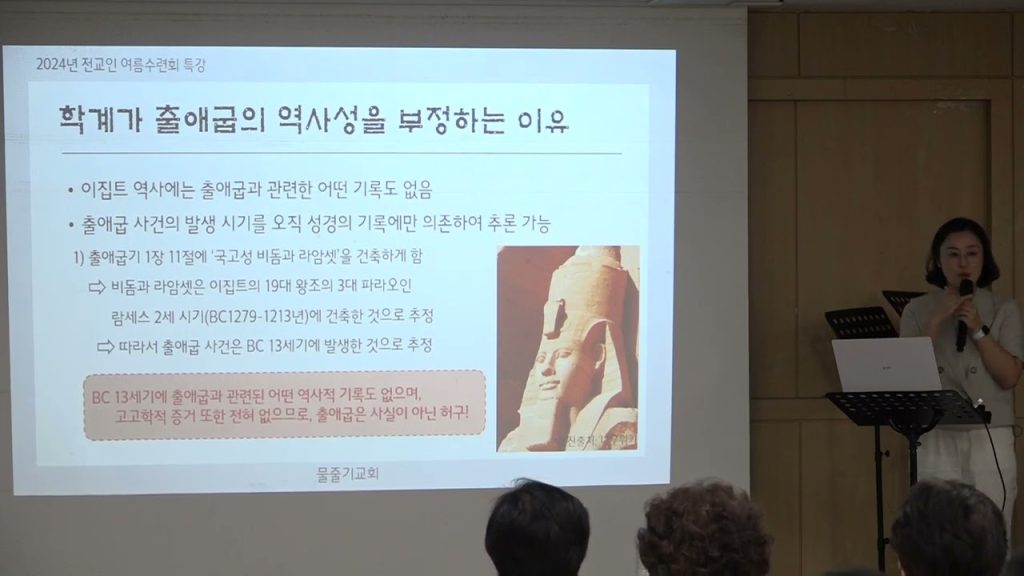
This passage examines archaeological and textual evidence to show that the Exodus was not simply a myth but a historical fact. Scholars dismiss the Exodus as myth on grounds such as the absence of records from the time of Ramesses II, but artifacts from the Middle Kingdom period that match the order of the biblical record are being found. A site thought to be Joseph's tomb, traces of canal works on the Nile, and the text of an Egyptian sage's warnings all contain things that fit the biblical account remarkably well.

In particular, the archaeological traces of the period when the people of Israel were exploited as slaves connect with traces of a sudden mass departure from Egypt after the ten plagues. This evidence shows that the Exodus was not an accident but an event thoroughly planned according to God's covenant with Abraham. If this event were not historical fact, the credibility of Jesus explaining his own ministry by comparing it to the Exodus would also collapse.

When the biblical record is shown to be historical fact, beyond mere parable or lesson, we can think again about what the foundation of our Christian faith is. We invite you to consider together what assurance God's work of salvation, actually carried out in history, gives our faith, and why the reasoning of scholars who try to turn away from this fact is dangerous.

Pastor Lee Ji-hyun · Jul 27, 2024