Skip to content

Sermons

A Sermon for the Outdoor Service
Proverbs

A Sermon for the Outdoor Service

A grandmother asked her granddaughter whom she loved most, but the girl answered that it was someone else, not her grandmother. Instead, she told her that she knew which books her grandmother liked and what kind of work she did.

God is asking us the very same question. Though he knows full well that we love the world more than him, he longs to hear that one word: that we love him. When Naomi left God, lost everything and came back, and when Ruth, with no claim of her own, turned her steps toward him, God rejoiced greatly at that single choice and opened his arms to embrace them.

Love that is never expressed remains unknown to the one who is loved. Even if we offered everything we have, it would be of little help to God; yet when we open our mouths and confess that we love him, he is proud of that heart and delights in it. We must be Christians who make God smile in this way.
Pastor Cho Chun-sook · May 26, 2019
A Judge the People Trusted
Judges, Part 16

A Judge the People Trusted

The men of Ephraim came to Jephthah and picked a quarrel with him for not calling them to the battle, threatening to burn him and his house down. Jephthah rebuked them, the two sides clashed, and forty-two thousand Ephraimites were killed.

Ephraim had raised the same complaint in Gideon’s day, and because the matter had been settled then with soft words, they expected the same approach to work again. What repeated itself was an old ambition: to stand at the center of Israel while sacrificing nothing of their own. Envy and jealousy, unless they are held in check, grow until they end in harming others. Jephthah, too, wanted to live among the upper class for the six years he was set up as judge; that desire drove him to vow his daughter as a burnt offering, and it cost him what was most precious to him.

No one knows how much time remains to them, which is why it matters to live today without regret. The judges pursued their own households, riches and glory rather than God, and did not teach the people the word; as a result Israel lost its faith and came under the oppression of the Philistines for forty years. Whether a leader or one of the congregation, only a life that is first approved by God will earn true trust from people as well.

Pastor Cho Chun-sook · May 19, 2019
The Daughter Who Must Die for Jephthah’s Vow
Judges, Part 15Judges 11:29-35

The Daughter Who Must Die for Jephthah’s Vow

On the eve of battle, Jephthah vowed that if he were given victory over the Ammonites, he would offer as a burnt offering whoever first came out of his house to meet him. When he returned from the battle victorious, the first to come out to greet him was his daughter, his one and only child.

Driven out by his half-brothers, Jephthah had lived among the lowest of society. Once he became head of Gilead, he assumed that whoever came out first to meet him would be a servant, and he made his vow thinking it would not matter if that person were sacrificed as a burnt offering. God did not prevent the moment when his daughter ran out ahead of everyone else. The anguish of a daughter who must die for her father’s wrongdoing calls to mind the suffering of Jesus, who died for our transgressions.

A vow should be made not out of greed but in thanksgiving for the grace we have received. Even when we feel wronged and long for revenge, we must leave it in God’s hands, wait patiently, and live holy lives with a pure faith.

Pastor Cho Chun-sook · May 12, 2019
I Will Deliver You No More
Judges, Part 14Judges 10:6-13

I Will Deliver You No More

Israel goes back to serving idols, and when oppression comes, the people cry out to God in repentance. This time, however, God answers differently. He reminds them, one deliverance after another, of how he rescued them from Egypt and from the Amorites, the Ammonites and the Philistines, and then tells them to go and ask the gods they have chosen to save them.

Israel sought God only when they needed him, and when peace returned they forsook him again, over and over. The judges, too, were divided: some left the people a true faith, while others, through their wealth and their many children, made the people envy the world. Depending on what their leader set before them, the people turned now toward God, now toward idols.

A believer who lives for self alone can never be happy, and those who turn away from God again and again may at last come to the place where he no longer answers. Yet God does not forget faithfulness offered from the heart, even for a short while; he remembers it. The sermon closes by saying that the faithful must put away grumbling, greed and self-righteousness, humble themselves, and become people who give themselves in sacrifice.

Pastor Cho Chun-sook · May 5, 2019
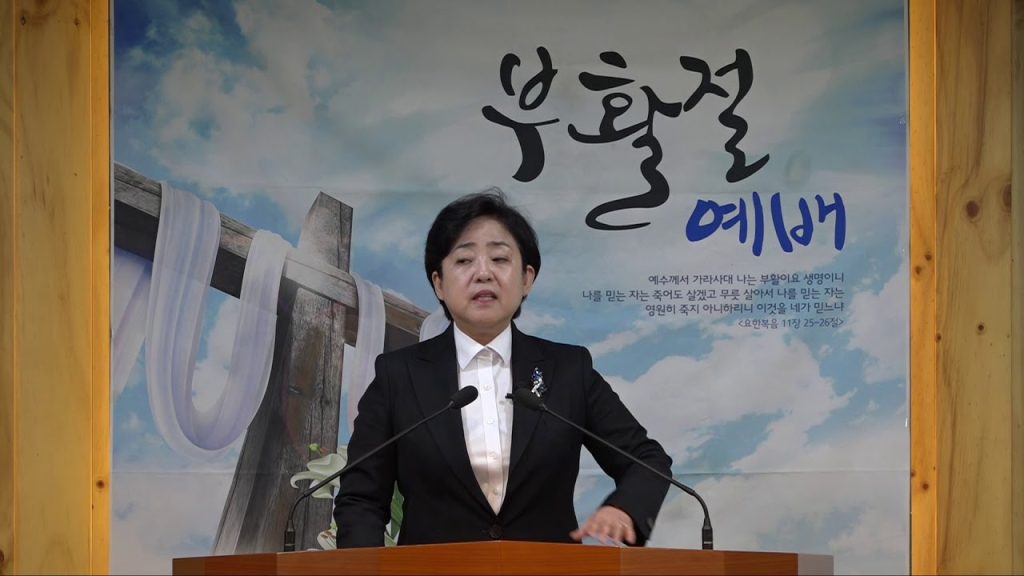
Restore This Nation [Easter]
EzekielEzekiel 36:18-31

Restore This Nation [Easter]

On the cross Jesus poured out both water and blood, and having overcome death, he rose again on the third day. Because he could not save anyone without giving himself up completely, he did not waver amid the temptation and mockery of Satan, but followed that road to the very end.

In Ezekiel’s day, leaders who fed only themselves left the sheep without a shepherd, and the flock was scattered and carried off into captivity. This nation, too, is now rotting from the root, as its spiritual and political leaders greedily exploit the people for their own gain. That is a sign of collapse from within, more frightening than North Korea’s nuclear weapons. Yet God would not let his name be profaned by Israel’s sin, and he restored them.

When God’s people receive a new spirit, when their hardened hearts are made tender and they keep and follow God’s statutes, this nation can be restored just as Israel was. Christians cannot overcome the wicked in their own strength. To rely on the risen Jesus Christ and pray for this nation and its people is the believer’s duty and the way to victory.

Pastor Cho Chun-sook · Apr 21, 2019
Gideon’s Fall at the Height of His Glory
Judges, Part 12Judges 8:21-28

Gideon’s Fall at the Height of His Glory

Gideon captured Zebah and Zalmunna, the kings of Midian, and brought the war to a complete end. Yet the first thing he did after his victory was to take the crescent ornaments from the necks of their camels. He then asked the people to gather their spoils for him, and from that gold he made an ephod and set it up in his own town of Ophrah.

It is human nature to cling to God in the midst of hardship, and then, once the hardship has passed, to be gripped by the conviction that one’s own judgment is right, and so to fall. The place where Gideon put his ephod was Ophrah, the very town where he had once torn down the altar of Baal and nearly lost his life for it. He wanted to show the people who had tried to kill him just how great he had become; it was a choice made not for God but for his own glory and for revenge.

Gideon went on to rule in peace for forty years, yet that silence was no blessing. God was no longer speaking to him. To hear the Word and be cut to the heart is the greatest miracle a person can receive. To stand at the height of glory without falling, a person must never forget who gave them that place, and must remain thankful always.

Pastor Cho Chun-sook · Apr 7, 2019
Gideon, Who Lacked the Character of a Judge
Judges, Part 11Judges 7:9-16

Gideon, Who Lacked the Character of a Judge

Gideon twice asked God for a sign with the fleece and had his answer confirmed, yet on the night before the battle, in a camp now reduced to three hundred men, he was once again doubtful and afraid. God told him to take his servant down to the enemy camp and listen to what was being said there, and in that camp, through the account of a dream about a barley loaf, God made the victory known in advance.

Gideon’s character remained unchanged to the very end. His was a faith that could barely manage a single step unless something was shown and explained to him, and God simply went on answering him at the level where he stood. Leaving only three hundred men, and bringing the victory through jars, torches and trumpets, were both meant to let the people know that it was God who had done it, not human strength.

Gideon gained the victory, yet because he never changed his character, his life was a failure. Only when a person breaks the jar that holds the self can the torch of Christ within be revealed. God’s people must put away a faith full of doubt and live by an honest one.

Pastor Cho Chun-sook · Mar 31, 2019
The God Who Loves Gideon to the End
Judges, Part 10Judges 6:25-32

The God Who Loves Gideon to the End

As God had commanded, Gideon took ten of his servants by night, tore down the altar of Baal, cut down the Asherah pole and offered a burnt offering. When the townspeople saw it in the morning and came crowding in, furious, Gideon did not step forward boldly but hid behind his father, and it was Joash’s wise words that saved his son’s life.

When God told him to offer the second bull, he was in fact calling Gideon to present himself as a living sacrifice. God had accepted his gift, promised that he would not die and even brought him the recognition of the people; yet Gideon put God to the test once more with the sign of the fleece. That request was answered not for Gideon’s sake but because God had a greater plan to save Israel.

A temple may fall short of perfection, and so may long years of faith. But God waits patiently, to the very end, until the one he has chosen has wholly fulfilled the calling entrusted to him. In later years Gideon came to betray God, and yet the love God had shown him was a love without conditions.

Pastor Cho Chun-sook · Mar 24, 2019
Gideon, Called
Judges, Part 9Judges 6:6-12

Gideon, Called

To escape the oppression of Midian, the people of Israel hid in the mountains. Gideon was threshing wheat in secret in a winepress, as though he were stealing it, when the angel of Yahweh came to him and called out, “Yahweh is with you, you mighty man of valor!” Yet even after hearing those words, Gideon argues back that all this has happened because God has abandoned them.

This is the picture of turning away from God to serve idols in times of peace, and then, when hardship comes, blaming God for not helping. God does not rebuke Gideon. He bears patiently with Gideon as he tries to excuse himself by saying he is not up to it, and promises again and again to raise him up as a judge. Even when Gideon insolently demanded a sign, the angel did not leave but waited for him, and only after the offering was accepted did Gideon realize that the one he had met was Yahweh.

At the place where the angel of Yahweh had left him, Gideon built an altar and called it ‘Yahweh Shalom.’ Gideon said he had neither resources nor wisdom, but a mighty man of valor is not someone who is strong. He is someone God is with. The faith with which one lives each day adds up to God’s reward or rebuke, so one must always keep oneself clean and ready.

Pastor Cho Chun-sook · Mar 17, 2019
The Song of Deborah
Judges, Part 8Judges 5:1-10

The Song of Deborah

Though he had been commanded to go and defeat King Jabin in battle, Barak refused to go unless Deborah went with him. As it turned out, the battle ended without difficulty, and the credit for killing the enemy commander fell to Jael, a frail woman.

Barak obeyed at once when the word promised blessing, yet faced with a command he had no confidence in, he tried to hide behind Deborah’s faith. Deborah, by contrast, led the way though she carried her own fear. When war broke out, she marked out, tribe by tribe, those who came to help and those who turned away to protect what was theirs, and preserved it all in her song.

Victory and defeat alike are God’s doing, but whether to obey or to draw back before him is each person’s own part. The portion of those who gave up what was their own to stand with the others is not the same as the portion of those who merely looked on.

Pastor Cho Chun-sook · Mar 10, 2019
Barak, Who Did Not Fully Obey
Judges, Part 7Judges 4:1-9

Barak, Who Did Not Fully Obey

Deborah brings God’s command to Barak, and with it a promise: if he leads ten thousand men to Mount Tabor, God will give Sisera and his nine hundred iron chariots into his hand. Yet Barak is afraid to go alone, and he says he will not go unless Deborah goes with him.

Deborah tells Barak that because he has not obeyed fully, the glory of this battle will go not to him but to a woman. As Barak comes down from Mount Tabor, God sends a heavy rain that floods the Kishon River and overthrows the iron chariots. Sisera flees and is killed in the tent of Jael, the wife of Heber the Kenite. The enemy Barak had searched for so hard is one he finds only lying dead on the ground.

God’s commands are not weighed by human judgment. Ability without resolve lets the reward prepared for someone pass to another. Obedience means stepping out without hesitation once God has answered.

Pastor Cho Chun-sook · Mar 3, 2019
The God Who Raised Up Judges
Judges, Part 6Judges 3:7-15

The God Who Raised Up Judges

When Israel cast God out of their hearts, he sold them into the hand of the king of Mesopotamia. After eight years of servitude the people cried out, and God raised up Othniel as judge to deliver them, giving them forty years of peace.

God gave Israel judges because human beings cannot save themselves. Whenever peace lasted long, Israel forgot to give thanks and fell back into sin, again and again, and each time God took up a rod such as Moab or the Philistines to turn them back. In calling those the world overlooks, like the left-handed Ehud and Shamgar, who drove back the Philistines with nothing more than an ox goad, God shows that he works not by human qualifications but by his own power.

To seek God only in times of need and cast him aside once satisfied is no different from the Israel we see here. Even so, God heard their cry and answered. Faith must be recognized not by how much or how little one owns, nor by worldly standing, but by a life lived according to the Word.

Pastor Cho Chun-sook · Feb 24, 2019