Skip to content

Sermons

Eternal Atonement and the Place of Grace
1 Kings, Part 91 Kings 8:1-11

Eternal Atonement and the Place of Grace

Solomon had every furnishing for the temple made new, yet the ark of the covenant alone was brought over unchanged from the tabernacle, where it had served. The priests carried it into the Most Holy Place beneath the wings of the cherubim, and the poles by which it was carried were left in place rather than drawn out.

The poles remained because God had commanded that they stay in the rings and never be removed. Inside the ark there was no jar of manna and no staff of Aaron that had budded, only the two tablets of stone, a sign that God’s concern lay with the covenant alone. Through all the years before, he had held unwaveringly to the covenant he made with Israel.

Neither God’s grace nor his miracles amount to anything if his people do not live by the Word. When the ark was at last set in the Most Holy Place of the temple, the glory of God filled it in the cloud, and the priests could not stand to minister. To believe and follow that covenant, which never changes, is the only way to remain in a beautiful relationship with God.
Pastor Lee Ji-hyun · Aug 4, 2024
The Exodus: History or Myth?

The Exodus: History or Myth?

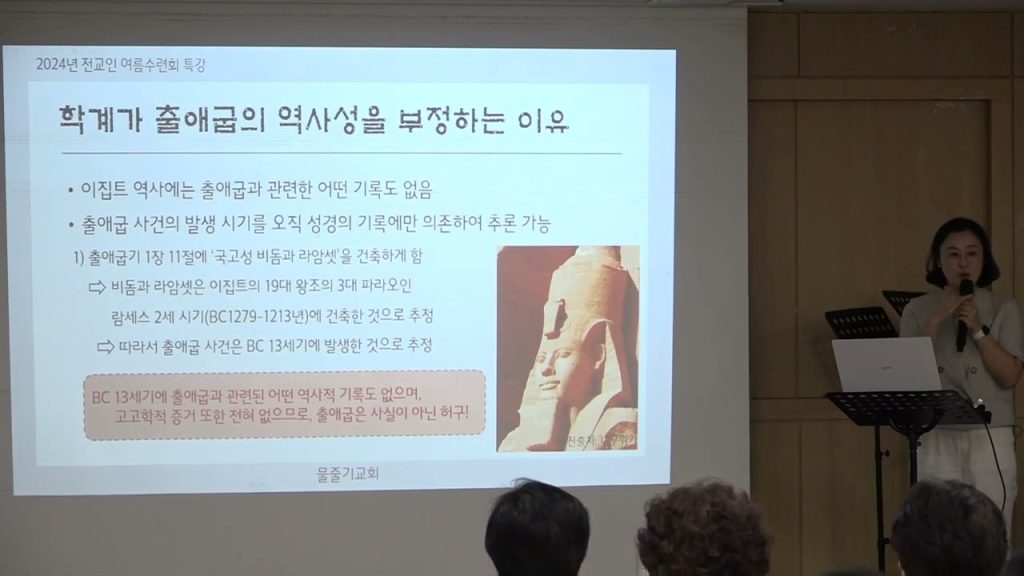
Moses commands the people to remember the day they came out of Egypt. Scripture records plainly that this was an event accomplished by the power of God. Yet the world would rather treat it as myth or literary imagination.

Scholars rest their case on the record of the building of the city of Rameses. On that basis they fix the Exodus in the reign of Rameses II, and because nothing from that period fits, they dismiss the Bible as myth. Yet the actual archaeological evidence (a settlement of foreigners, remains that appear to be the tomb of Joseph, Semitic names preserved in a list of slaves, a city abandoned in haste along with traces of burials, the writings of an Egyptian sage, and the Israel Stela) all points to the Middle Kingdom, an age earlier than that of Rameses. Having placed the event in the wrong period, they have then claimed there is no evidence for it.

Once the evidence is set in its proper period, it agrees remarkably with the biblical record. The suggestion that the Exodus be read not as history but only as metaphor and moral lesson is attractively packaged, nothing more. Take away the historical ground of Scripture, and the theological truths built upon it fall with it. The Exodus is a historical fact, planned from the time of God’s covenant with Abraham, and it is the foundation both of Israel’s identity and of knowing who God is.

Pastor Lee Ji-hyun · Jul 27, 2024
The Miracle at the Red Sea and the True Location of Mount Sinai

The Miracle at the Red Sea and the True Location of Mount Sinai

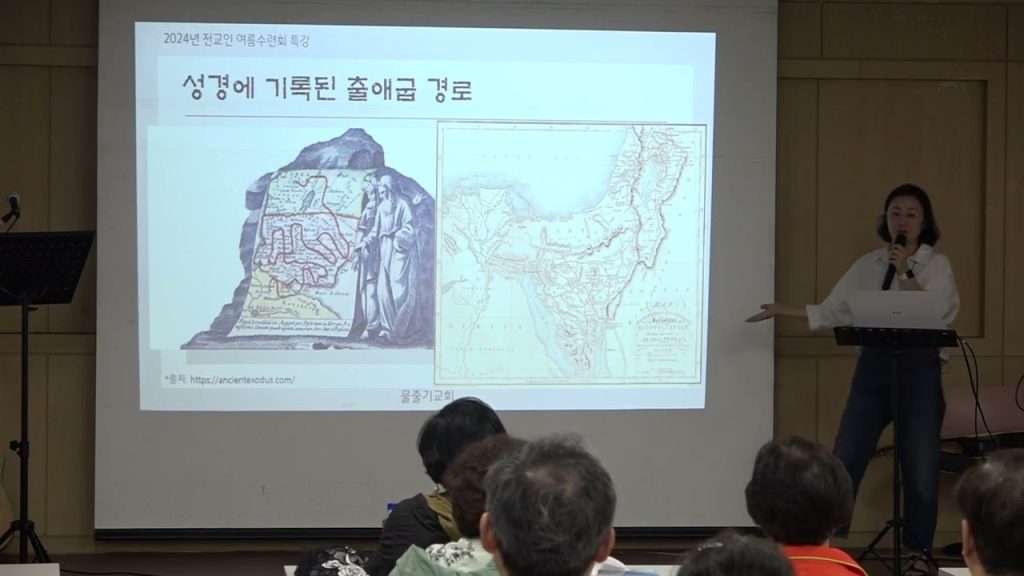
The road the Israelites took out of Egypt was an eleven-day journey, yet they wandered its course for forty years. The traditional sites of the Red Sea and Mount Sinai fail to match the biblical text at several points. The Gulf of Suez is shallow and narrow, so it is hard to picture a people who had left in haste crossing there. The mountain on the Sinai Peninsula is no more than a site the Church in Rome designated on conjecture in the sixth century.

Scripture describes the Yam Suph as great, deep and wide waters that stood like a wall on either side. Off Nuweiba in the Gulf of Aqaba, the width and depth of the sea, its gentle slope and even the remains of chariot wheels found there all fit that account. On the far shore, Jabal al-Lawz likewise has what Mount Sinai ought to have: a scorched summit, stone pillars for the twelve tribes, traces of the altar Aaron built for the golden calf, a flowing stream and a cave.

These events lie 3,500 years in the past, so none of this can be settled for certain. Yet such traces bear witness to God at work in real history, not in a parable on paper. Even so, as Jesus said to Thomas, “Blessed are those who have not seen, and have believed.” In the end faith is not produced by evidence. It is received only when God gives it as a gift.

Pastor Lee Ji-hyun · Jul 27, 2024
God’s Work and Man’s Work
1 Kings, Part 8

God’s Work and Man’s Work

Solomon built the temple, and after it his own palace. The palace was twice the size of the temple and took twice as long to build, yet Scripture gives it a mere twelve verses, set in the middle of the account of the temple’s construction.

Measured by size or by time, the palace was the greater undertaking, but what Scripture keeps at its center is the temple, not the palace. The furnishings of the temple were made by Hiram, the son of a Jewish mother and a Tyrian father, who grew up without his father. God, who does not judge by outward appearance, made this man the one in charge of the temple’s building. The two pillars raised at the temple entrance, Jachin and Boaz, likewise declare that it was established not by man but by the power and authority of God, and the bronze Sea and the basins show that only after being washed clean could anyone enter the holy place, filled with gold.

Temple and palace alike are nothing more than instruments, given so that God’s people might fulfill the calling he has entrusted to them. Just as the temple, not the palace, was meant to stand at the heart of Israel’s history, so God, not self, must stand at the center of our lives. When the work of God comes first, we come to live a life that God himself establishes and fills.

Pastor Lee Ji-hyun · Jun 30, 2024
The God Who Fulfills His Word
1 Kings, Part 7

The God Who Fulfills His Word

Solomon begins building the temple four years after he becomes king. Yet the text dates this moment alongside another fact: it was the four hundred and eightieth year since Israel came out of Egypt. The tabernacle had wandered through the wilderness, and now it was becoming a temple settled in one place. The promise God had given Israel through Moses was fulfilled only after all those long years.

Neither the tabernacle nor the temple is itself God. Each is simply the place God appointed for meeting his people, and no amount of human devotion can confine him within its walls. God said the same to Solomon once the temple was finished. What matters is not the building but obedience that keeps his statutes, and he will never go back on the promise he made to David.

The faithful God always brings to pass what he has spoken. The same promise of his presence runs from the tabernacle to the temple, then to Jesus Christ, and on to us, his people. Even when we are troubled and weak, we can lean on the faithful God and go forward one step at a time. That is the way of faith that shines to the very end.

Pastor Lee Ji-hyun · Jun 16, 2024
Worship as Serving One Another

Worship as Serving One Another

Only two months have passed since the first leaves appeared on the hills, and already the trees and flowers are in full growth. In that season the congregation gathers for an outdoor service. The word worship carries two meanings: the homage of bowing down before God, and the service and ministry offered to one another.

The peace offering of the Old Testament and the Lord’s Supper of the New hold both meanings together. They speak not only of a relationship with God restored but also of the meal and fellowship shared among God’s people. Worship, then, is not merely taking one’s place at the appointed hour; it is the whole of a life spent loving one’s brothers and sisters and giving oneself for them.

Christians labor not for their own honor but for Christ, and so they must lay down their own will and work together. Loving and serving one’s brothers and sisters is no condition for gaining salvation; it is the fruit of the salvation already received through the cross, made visible in daily life. To love and respect one another sincerely, here where the church has gathered today, is itself the worship offered to God.

Pastor Lee Ji-hyun · May 19, 2024
The God Who Provides
1 Kings, Part 61 Kings 5:1-8

The God Who Provides

When Solomon came to the throne, Hiram king of Tyre sent envoys to congratulate him. In return Solomon asked him to send cedar and craftsmen for the building of the temple, and Hiram, greatly pleased, praised God and gave his help gladly.

David had shed much blood in war, and so building the temple was not his calling. That calling passed to Solomon, to whom God had granted peace throughout the land, and he made it plain to Hiram that this temple was both his father’s wish and the fulfillment of the covenant made with God. The riches, the workers, the friendship of a foreign king: all of it God had prepared beforehand.

Weigh up the credit for building the temple, and Solomon himself did not do a great deal. Even so, as a foreshadowing of Jesus Christ, the Prince of Peace, he took up that precious charge. We too have no merit to claim, yet God has called us his children and entrusted us with the task of living through the last days carrying the lamp of truth.

Pastor Lee Ji-hyun · May 5, 2024
The Prosperity of Solomon
1 Kings, Part 51 Kings 4:20-25

The Prosperity of Solomon

Solomon is the only king in Israel’s history to have ruled over all Israel from the beginning of his reign to its end. He appointed twelve district governors and charged them with providing for the royal household. The people grew as numerous as the sand by the sea, the land stretched as far as the Euphrates, and the people enjoyed peace under their vines and fig trees.

This abundance was not the reward of Solomon’s own brilliance. It came because God fulfilled, just as he had spoken, the covenant he made with David and the promise he gave at Gibeon. Yet even Solomon, for all his wisdom, stirred up resentment among the other tribes, Ephraim above all, through a policy that spared the tribe of Judah alone from taxation, and by multiplying horses and chariots he broke the command God had given concerning Israel’s kings. Even the wisdom and breadth of heart that God bestows become an opening for corruption when they are not used according to his will.

The cracks of Solomon’s reign became the seed of the kingdom’s later division. Had he gone on trusting God alone with the faith he first had, walking in humble obedience, the outcome would have been different. God looks for those who lean not on the strength of the world but on him alone, and still today he works in those who take one humble step of obedience.

Pastor Lee Ji-hyun · Apr 14, 2024
Solomon Asks for Wisdom
1 Kings, Part 41 Kings 3:4-10

Solomon Asks for Wisdom

Solomon offers a thousand burnt offerings at the high place in Gibeon. That night God appears to him in a dream and tells him to ask for whatever he wishes. Solomon asks neither for long life nor for wealth and honor, but for a listening heart that can discern between good and evil.

In the original language, this listening heart is a heart that hears the word of God and obeys it just as it is spoken. Later, when two women quarrel over one baby, Solomon orders the child divided in two. That ruling brings to light the heart of the true mother, who wants only to keep her child alive, and the baby is spared. The people who heard of the ruling stood in awe of the king and gave glory to God.

Asking for wisdom does not mean that wise decisions come of themselves. Wisdom shows itself when what was asked for is lived out according to the Word. When the church and God’s people hold fast to the Word and live by it, a life-giving authority is restored in the very place where they stand.

Pastor Lee Ji-hyun · Mar 17, 2024
Those Who Missed Their Chance
1 Kings, Part 31 Kings 2:31-38

Those Who Missed Their Chance

After Adonijah is put to death and Abiathar is driven out at David’s command, Joab takes hold of the horns of the altar in Yahweh’s Tent. But unlike Adonijah, he is put to death at once. Shimei had cursed David but survived, and instead of putting him to death, Solomon commands him to live only within Jerusalem.

Joab served David loyally for more than forty years, but to keep his own position he deliberately killed Abner, Absalom, and Amasa, who had no strength to resist. Because deliberate murder cannot be escaped even at the altar, his death was the response to that sin. Shimei was given the chance to keep his life twice, first because of David and then because of Solomon, but he took grace lightly and treated his oath carelessly, and in the end he left Jerusalem and was put to death.

When the wicked are not punished as soon as they sin, it means they are being given a chance to turn back as they go on living. Joab and Shimei failed to take hold of that chance and fell back into their own greed and complacency. This is also why we have nothing to boast of in what we have done well. It is nothing more than one more chance at a good choice, received by the grace of God.

Pastor Lee Ji-hyun · Feb 4, 2024
The End of the Foolish
1 Kings, Part 21 Kings 2:1-9

The End of the Foolish

As death drew near, David left his final charge to Solomon. He first passed on a blessing, urging him to keep the word of God, and then commanded him to deal wisely with those who had done him wrong.

Adonijah had committed the grave sin of trying to seize the throne, yet he was pardoned; but he could not be thankful for that grace. Where gratitude had faded, resentment took its place, and in the end his foolish desire to have Abishag, his father’s woman, as his wife cost him his life. Abiathar was the priest who had stood by David at the risk of his own life in his hardest days, but when David grew old, anxious for his own future, he went over to Adonijah’s side.

Adonijah, who so readily forgot the grace he had been shown and set out to satisfy his own desires, and Abiathar, who let the faith he had kept all his life give way at the very last — both came to a sorry end. To live soberly and watchfully before God, thankful for the grace received and content with what one has: this is the life of God’s people who are wise and true.

Pastor Lee Ji-hyun · Jan 14, 2024
The One Who Exalted Himself and the One Who Was Raised Up
1 Kings, Part 11 Kings 1:24-30

The One Who Exalted Himself and the One Who Was Raised Up

As King David grew old without naming a successor, his fourth son, Adonijah, put himself forward to be king and gathered chariots, horsemen and an escort of guards. He had the birthright, a handsome appearance, and even the backing of Joab and Abiathar, yet Solomon was the one man he did not invite to his feast.

Adonijah rested his claim to the throne on his birthright and his looks, but Scripture says that God looks not on the outward appearance but on the heart. Solomon did nothing to win the crown, yet even before he was born he had been chosen and loved by God. In the end the prophet Nathan and Bathsheba went in and spoke before David, and in a moment everything was overturned: Solomon took his seat on the throne, and Adonijah was left clinging to the horns of the altar, begging for his life.

Unlike Adonijah, who sought to exalt himself, Solomon had done no more than live quietly and faithfully in his own place, and it was God who raised him up. Rather than rushing to and fro after results they can see, God’s people must be faithful in small things right where they now stand, and wait for God’s appointed hour. Even when no one seems to be watching, God searches the heart, and when that hour comes he will without fail bring them into their rightful place and use them.

Pastor Lee Ji-hyun · Dec 17, 2023